By Howard Aru
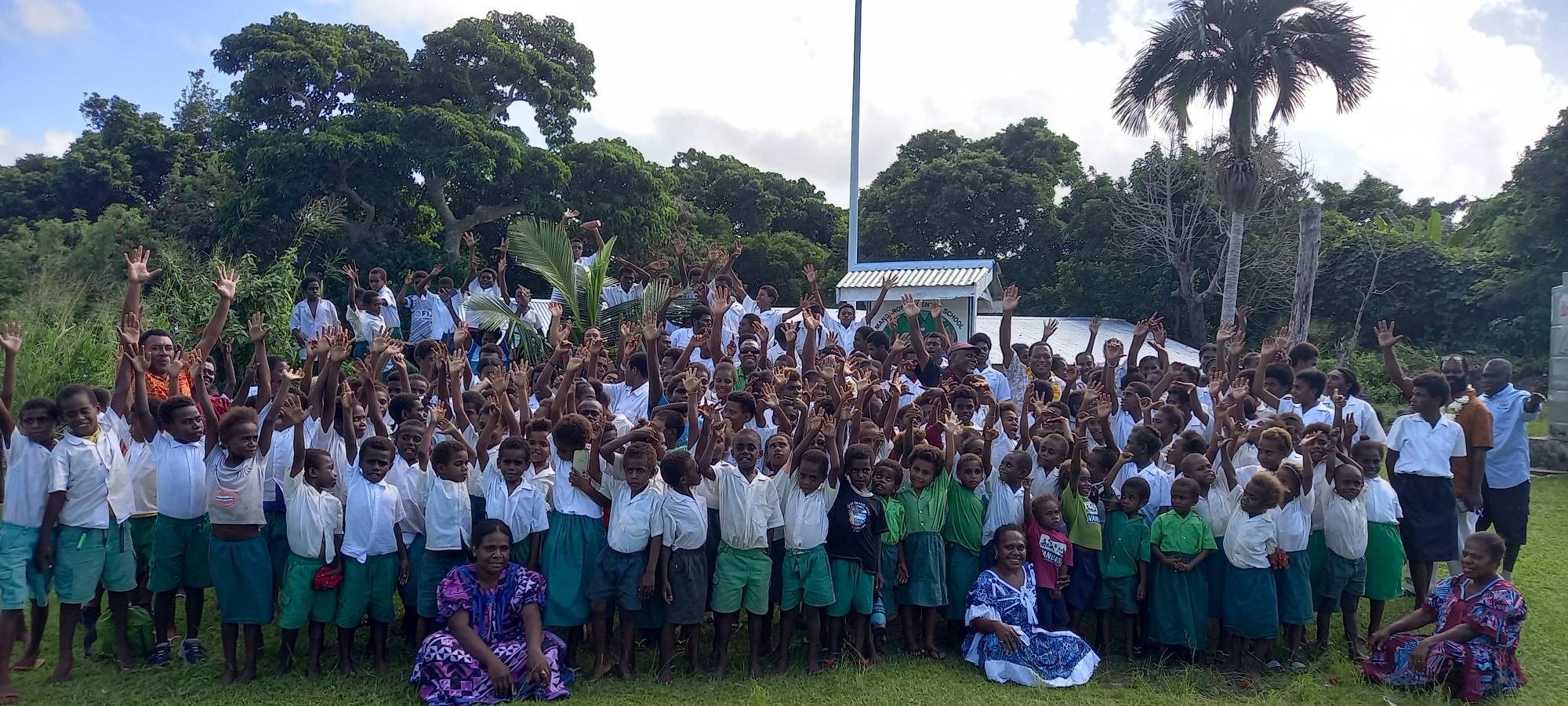
The Minister of Education and Training’s first ministerial visit to Emau and selected schools around Efate ended last Friday (10 April) at Ulei School, North-West Efate. Coincidentally, Ulei also closed its ‘Reading Week’ that day.
We were extremely privileged to join the closing ceremony—their ‘Reading Competition’. For me personally, this made my day. I had passionately advocated for “reading” in schools all around Efate and Emau during the two-week tour.
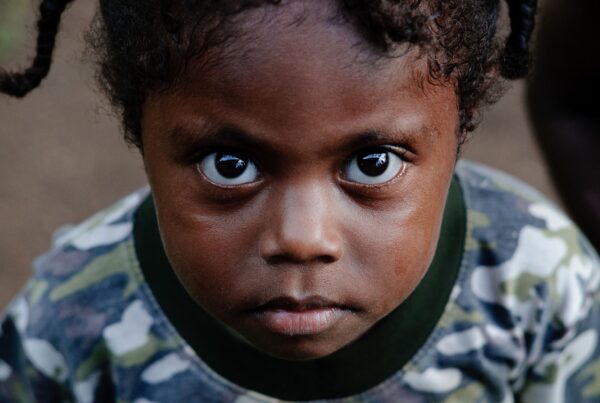
Ulei’s programme cemented this very fact: that reading is key to uplifting and rescuing our children from a failing education system. I feel for young Jimmy and his colleagues at Roau French School, Mangaliliu village, who sat there and listened very attentively to the Hon. Minister while he gave his speech. A boy who, if properly and rightly trained, would one day become a pilot, a doctor, a teacher, a director, or a well-educated Member of Parliament.
The burning question, though, is: what kind of education are we feeding these children? Minister Johnson referred to these lovely kids throughout the tour as “gold” in the hands of parents and schools. Yes, these are precious jewels. But we’re faced with a serious dilemma—the alarming failure rates.
Massive failure rates
As Tony Batten of Pikinini Playtime (P.Play) wrote in last weekend’s paper, “Only twenty percent of those who start kindergarten manage to graduate from Year 10.” Make it 25% if you so wish—still shocking. He continues, “the rest, eight out of every ten students, drop out or fail, and most are functionally illiterate.”
Play has had to employ additional staff to help children transferring in from government schools and to try to improve their appalling literacy standards.
The vast majority of children in Vanuatu are being condemned to a life of illiteracy, written off and discarded. In a way, these are the results of the half-baked ‘Vanuatu National Language Policy’ launched by the then Minister of Education in 2012.
Here’s a brief review ofthe said policy. Page 3 reads, ‘Seventy-five percent (75%) of all students achieve an agreed standard of literacy in either French or English by the end of Year 8.’ Reality check: the exact opposite. Page 8 reads: ‘Developing literacy in a vernacular language [including Bislama] leads to stronger intellectual development.’ Reality check: an embarrassingly massive illiteracy rate 14 years on. Page 11 reads: by Year 9 and 10, ‘students should have achieved an agreed level of literacy and be reasonably fluent readers, writers, and speakers of French and English.’
Ask Tony Batten of P.Play or Mrs. Donna J. Tabilepo, owner and Principal of Donna’s Elite Foundation English Grammar School—they’ll tell you the brutal, unvarnished truth. So, we listened to those so- called ‘drivers of change’ and swallowed it line, hook, and sinker, and now we’ve landed ourselves in a deep trench. It is high time now to say enough is enough. Scrap Bislama from schools! It’s been fourteen years—why has this policy not been reviewed earlier? This is mind-boggling.
Theory vs Practice
The original policy intent behind this policy was for teachers to only explain things in Bislama (especially in schools in urban areas) when students needed to understand concepts. Guess what? With our current very poor school and teacher inspection system, two things have happened. Firstly, the curriculum for Years 1–3 was translated into Bislama. And secondly, some confused, or perhaps lazy, teachers are now teaching entirely in Bislama in certain schools in Port Vila. They’ve forgotten their language of instruction—English and French! Even the teachers of a certain Francophone school just outside Port Vila have complained about this during a recent visit under a World Bank Education Sector Review (ESR) project.
Vernacular (and Bislama) in schools was funded by foreign partners—well-intentioned, maybe, but totally flawed and a complete betrayal of the trust of parents who expect their children to learn English and French and to excel in their studies, graduate, find jobs, and interact with the rest of the world in English and French.
It is therefore high time to dismantle the whole policy behind Bislama and salvage our education system, and rescue the poor children who have been mercilessly victimised by the human disaster this bad education policy has caused across the country.
We’ve vigorously debated this subject before. Ishmael K. Maau’koro’s government shelved Bislama during his brief tenure as Prime Minister (late 2022 – Sept 2023). Debates raged on social media back then. Three years on, where have we gone? Down the drain at breakneck speed.
Very sadly, some of our Ni-Vanuatu “linguists” and policy implementers, who to begin with were never taught in Bislama when they were students in primary and secondary schools, have been some of the most vocal advocates and defenders of Bislama in schools as a ‘vernacular’. This is absolute madness.
These linguists speak and write almost perfect English and French because they were strictly taught in English and French, not Bislama, during their formative and primary schooling years. Yet they are fully prepared to defend and feed this garbage (Bislama) to children across the country.
Argue until the cows come home if you may, but where is the evidence-based research to prove Bislama has made positive changes in students’ lives? How do we fix the situation? Let’s start with reading. Just like Ulei School is doing. Get kids to read. Introduce reading weeks in schools. Programme reading into school weekly calendars. Dr Ben Carson, America’s renowned Black neurosurgeon, was the “dummy” in the class until his uneducated mother made him read books every week.
Foster a reading culture in schools
Let’s pause here for a moment and ask two very basic questions. Firstly, when should children be taught to read? Normally between ages 4–7. Foundational skills such as phonics are best taught between ages 3–6.
While formal instruction often begins in kindergarten, children benefit from early exposure to books and reading aloud from as early as infancy. Secondly, why is reading important? Reading is to the mind what exercise is to the body (as coined by Joseph Addison).
It stands absolutely true to this very day and remains the country’s biggest education sector challenge today. Reading keeps the mind sharp, active, and healthy, just as physical exercise does for the body, fostering intellectual and mental strength.
Remember, language shapes thought. Reading is a fundamental principle of learning. It trains the mind to understand English (or French), maths, and all the other subjects taught in schools; to write essays, sit exams, graduate, and find jobs.
When I was attending primary school at Sanlang School, West Vanualava, I recall we had to read for an hour every single day. Ulei School just completed its ‘School Reading Week’ last Friday. Why? Because its principal, Ms Makin Valia, deeply understands the importance of reading.
The school ended its week-long event with a ‘reading competition’ by the students. Why such events? To help strengthen the students’ intellect and their ability to read, write, and understand the subjects they are taught in schools. With that in mind, why on earth Bislama in schools? What kind of literacy policy is this?
A policy which has literally wrecked the education of thousands of innocent children across this country over the past decade?
It is high time to proactively address the issue of reading in schools in order to salvage our failing education system. Reversing our current high illiteracy rate may take several years to correct, but it must be done.
The upcoming Principals’ Conference and the National Education Forum must also address this language policy issue.
I like Tony Batten’s analogy of officials at MoET being like deer caught in the headlights of an oncoming car. They shake their heads, mutter about this issue, then move on as if all is well.
Decisive action must be taken now to rescue the situation across Vanuatu. There is no choice but to act and deal with it. If not, what will there be to show for the education sector when ‘Yumi 50’ is celebrated in 2030?
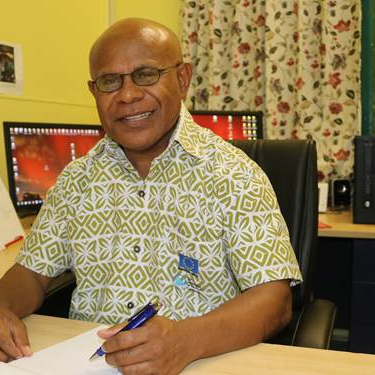
While Howard Aru has held senior roles in various Government ministries, institutions, and the private sector, the views expressed here are solely his own and do not represent those of any organisation with which he is affiliated.